297 Probe Failures and One Curly Apostrophe: Wiring Two Macs Into an MLX Cluster
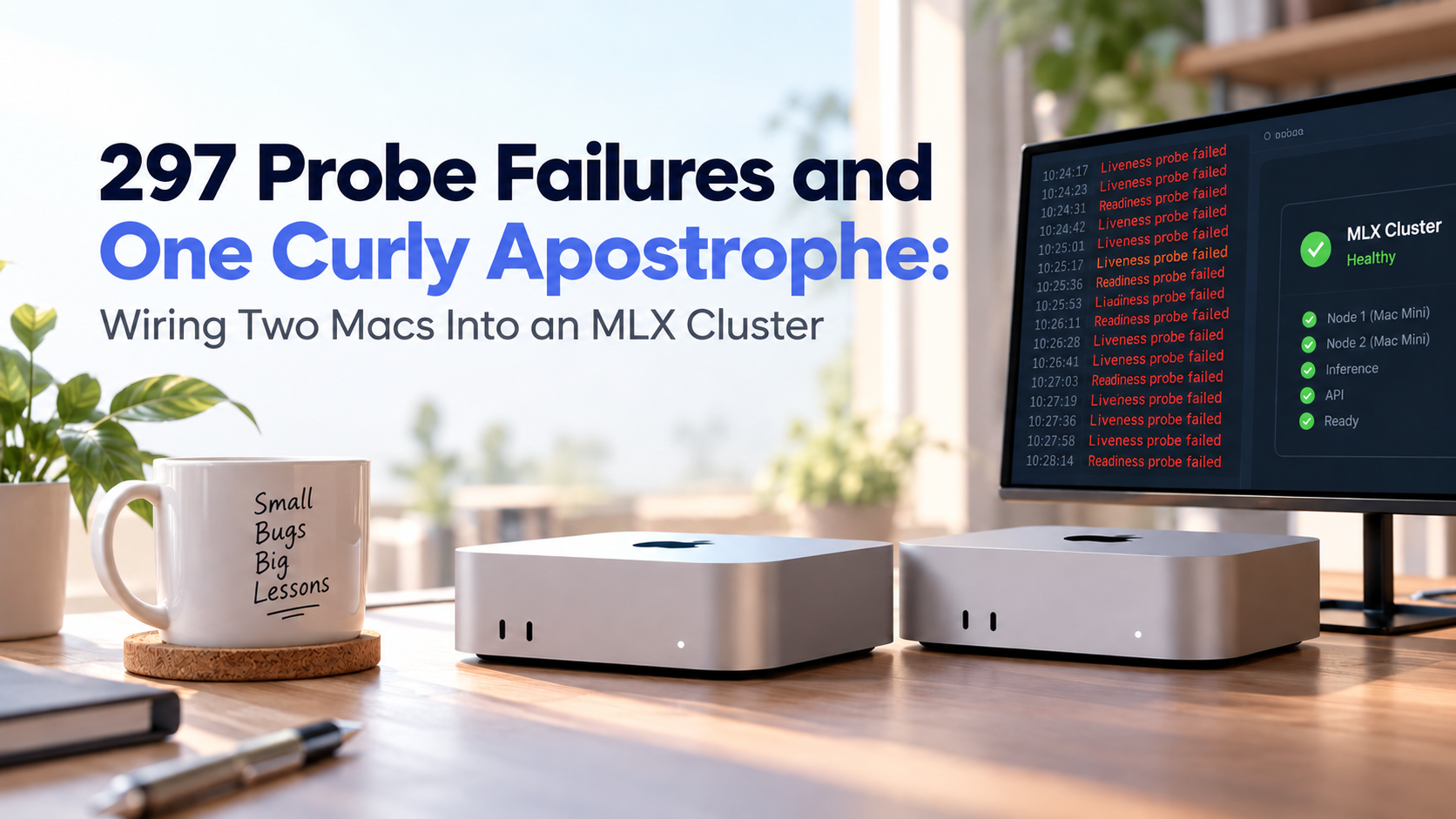
Every error message pointed somewhere the bug was not
Two Mac minis, a Thunderbolt cable, and a branch that was supposed to be ready to merge. What follows is the log of getting them to act like one machine. Every number below was read off the hardware or out of a tool, not recalled.
The 56,190-Line PR
A knowledge-graph cache rode into a feature branch and nobody noticed.
The branch added subnet discovery, a host inventory and SSH key provisioning. Reviewing the diff against main produced this:
67 files changed, 56190 insertions(+), 3 deletions(-)
 omlx/cluster/graphify-out/graph.json    | 52477 +++++++++++++++
 omlx/cluster/graphify-out/manifest.json |   296 +
 ... 53 more cache files ...
A tool had been pointed at omlx/cluster/ rather than the repo root, so it wrote its extraction cache inside the package. The repo’s .gitignore had no entry for it — verified with git show HEAD:.gitignore, zero matches — so a git add -A swept in 55 files, 3.6 MB alongside the real work. The commit message mentioned none of it.
Find & Replace Broke English
Scrubbing a word from a codebase is not a text operation.
An earlier cleanup had removed every mention of a certain configuration-management tool from the source. It worked, in the sense that the grep came back empty. It also produced this, in five places:
# omlx/cluster/inventory.py
"""cluster-style cluster host inventory backed by a private YAML file."""

# omlx/cli.py
help="Manage the cluster-style host inventory file"

# omlx/cli.py — the flag now documents itself as itself
help="Existing SSH private key used to authenticate (--private-key)"
A blind substitution of one noun for another leaves grammar behind. Worse, the removal was cosmetic where it mattered least and absent where it mattered most: the commit messages still carried the word, so the history a reviewer reads was untouched.
A Dot Is Not An Injection Vector
A hardening patch that rejected every real SSH key.
The provisioning code interpolates a public key inside single quotes in a remote command, so it validates the key first. Reasonable. This was the validator:
_AUTHORIZED_KEY_RE = re.compile(
    r"^ssh-(ed25519|rsa) [A-Za-z0-9+/=]+(?: [^\n\r'\"\\;`$&|<>.!*?~\[\]{}]{0,4096})?$"
)
Note the . inside the excluded set. The comment field of an OpenSSH key is, by default, user@hostname. Hostnames contain dots. Tested against the validator:
False | ssh-ed25519 AAAA... operator@node-a.local
False | ssh-ed25519 AAAA... test@example.com
True  | ssh-ed25519 AAAA... omlx-cluster
Only the project’s own hard-coded comment survived. Any key an operator actually generated was rejected with “invalid SSH public key format”. A dot cannot terminate a single-quoted shell string; the only characters that can are the quote itself, CR and LF. The fix was an explicit allowlist that excludes exactly those and permits the rest.
Two more in the same file:
# Not an escape sequence. SyntaxWarning today, SyntaxError later.
if any(c in public_key for c in "\"';\$&|<>`"):

# Copy-pasted message in the SSH path
raise ValueError("sweep port must be between 1 and 65535")
And an untyped CLI flag: --ports had no type=int, so a non-numeric value sailed past argparse and reached int() deep in the socket layer, producing a raw traceback instead of a usage error.
Rewriting History Without Losing It
Four commits became two, and the 3.6 MB never existed.
Dropping the cache from the tip would have left an add-then-delete pair in the history. Since the branch was unmerged, the correct move was to rebuild it: collapse to the merge base, drop the cache from the index, commit the real work as one change plus one ignore rule.
Before anything destructive, the old tips went into a bundle outside the repo:
$ git bundle create ~/backups/pre-rewrite.bundle \
      backup/pre-rewrite origin/feat/branch ^main
$ git bundle list-heads ~/backups/pre-rewrite.bundle
2502e576... refs/heads/backup/pre-rewrite
f0bcb00e... refs/remotes/origin/feat/branch
291K
291 KB, holding both tips, verified with git bundle verify. The local backup branch was then deleted so no stray ref could ever be pushed. The result:
| Before | After | |
|---|---|---|
| Commits | 4 | 2 |
| Files in PR | 67 | 13 |
| Insertions | 56,190 | 1,633 |
| Cache files | 55 | 0 |
GitHub Says 422
You cannot reopen a pull request whose head you rewrote.
The PR was closed. Force-pushing the clean branch and reopening should have been mechanical. It was not:
$ gh pr reopen 2672
API call failed: GraphQL: Could not open the pull request.

$ gh api -X PATCH repos/OWNER/REPO/pulls/2672 -f state=open
{"message":"Validation Failed","errors":[{
  "field":"state",
  "message":"state cannot be changed. The branch was force-pushed or recreated."
}]}
A closed PR can only be reopened while its head branch still points at the SHA the PR recorded. The force-push had moved it. The recovery used the bundle:
- Fetch the old head SHA back out of the bundle
- Rewind the remote branch to it, leased against the new SHA
gh pr reopen— succeeds- Force-push the rewritten history back, leased against the old SHA
The public branch sat at the old commit for roughly fifteen seconds. Both pushes used --force-with-lease pinned to an explicit SHA, so either would have aborted rather than clobbered an unexpected state.
Six Plays, Two Macs
The control node cannot run the code it deploys.
Verification needed real hardware: an 8 GB M2 Mac mini and a 16 GB M4, cabled over Thunderbolt. The orchestrator is a Linux laptop that cannot import MLX at all, so it stays a pure driver — every assertion runs on a Mac, over SSH.
Deployment Topology
Six tagged plays: prereq, preflight, deploy, test, fabric, verify. The fabric assertions run Mac to Mac in both directions, never from the control node — which turned out to matter, because the control node reaches a completely different device at the Thunderbolt subnet’s address via its default gateway.
The 2 GB Trap
One missing exclude, two machines, hours of rebuild.
Pushing the tree from the control node means rsync --delete. The virtualenv on each Mac lives inside the repo path and holds a compiled MLX:
$ du -sh /Users/dk/Documents/git/omlx/.venv
2.0G
Without --exclude=.venv, a deploy silently deletes it on both nodes and every later step fails because the interpreter is gone. Ansible’s synchronize module makes this easy to get wrong — it has no exclude: parameter. Confirmed against the module documentation, whose option list runs archive, checksum, compress, copy_links, delay_updates, delete, dest, dirs, existing_only, …, rsync_opts and contains no exclude. Excludes must go through rsync_opts as literal flags.
The dry run is the whole safety story:
$ rsync -az --delete --dry-run --itemize-changes \
      --exclude=.venv ... control:/repo/ mac:/repo/ | grep deleting
*deleting .git/objects/pack/pack-8376....pack
*deleting .ruff_cache/0.16.3/13669949980515150722
.venv mentions: 0
The play also asserts the interpreter still exists after the sync, so the failure mode is a red assertion rather than a silent two-gigabyte hole.
The Test That Never Failed
Diagnosed as a broken test. It was a broken harness.
First full run: 49 passed, 1 failed, identically on both machines.
FAILED tests/test_cluster_provisioning.py::test_ask_pass_path_never_persists_password
E   ProvisioningError: --ask-pass requires the sshpass binary
The obvious reading: the test mocks subprocess.run but not shutil.which, so it depends on a real binary and is not hermetic. Patch the test. That reading was wrong, and it would have modified a public PR to paper over a local misconfiguration.
Installing sshpass did not fix it. That is when the real cause showed up:
$ ssh mac 'echo $PATH'
/usr/bin:/bin:/usr/sbin:/sbin

$ ssh mac 'python -c "import shutil; print(shutil.which(\"sshpass\"))"'
None

$ ssh mac 'PATH=/opt/homebrew/bin:$PATH python -c "..."'
/opt/homebrew/bin/sshpass
Non-interactive SSH gets a minimal PATH with no Homebrew prefix. The binary was installed and invisible. The environment block had been set on one play and not the others. Adding it everywhere took the suite to 50/50 on both nodes, and the PR needed no change at all.
A Runtime That Was Already There
The dashboard reported a missing install. Both nodes had the same build.
The cluster page refused to proceed:
Both machines had the same application version installed. Both answered cluster status --json correctly, reporting distributed_backends: ["ring", "jaccl"]. So the message was false — and reading the source explained why it is always false in this situation. The function that produces it is documented as the path taken before a runtime exists, and it hard-codes its own verdict:
def probe_remote_system_host(...):
    """Inventory an SSH host before the worker runtime is installed."""
    ...
    "worker_runtime_ready": False,
    "runtime_mismatches": ["oMLX worker runtime is not installed"],
The real question was why the coordinator fell back to it. The chain:
Why The Probe Fell Back
The coordinator runs inside a packaged application, so its sys.executable is the app’s bundled interpreter. It SSHes to the peer and runs that same absolute path with -m omlx.cli. The path exists on the peer — both machines have the app — but the bundled interpreter cannot import the package without the launcher that assembles its module path. A comment in the source warns about exactly this hazard.
Discovery then walks nine candidate interpreters, each required to import omlx. It looks for ~/.omlx/bin/omlx-cluster-python. The application ships ~/.omlx/bin/omlx — a shell launcher, not an interpreter. The one interpreter on the machine that can import the package was not on the list. Discovery raised, and the caller fell back to the function that always reports a missing runtime.
Creating the file the search was already looking for closed it:
#!/bin/sh
exec /Users/dk/Documents/git/omlx/.venv/bin/python "$@"
297 Times, Every Ten Seconds
“Needs Attention” was one probe, not an unstable cluster.
With the runtime recognised, the dashboard began cycling: ready, then Needs Attention, then ready. That reads like a flapping link and it is the kind of thing that erodes trust in a system fast. The server log said otherwise:
03:02:58 WARNING POST /admin/api/cluster/node-budgets → 503
         memory ceiling probe failed for Deepaks-Mac-mini.local: Traceback
           File "<string>", line 10, in <module>
         ModuleNotFoundError: No module named 'omlx'
03:03:09 WARNING POST /admin/api/cluster/node-budgets → 503   (same)
03:03:18 WARNING POST /admin/api/cluster/node-budgets → 503   (same)
         ... every ~10 seconds ...
The same unimportable module, on a different code path. The budgets endpoint calls a separate, deliberately minimal memory probe:
capacity_bytes = await asyncio.to_thread(
    probe_remote_admission_ceiling,
    host.ssh,
    python_executable=host.python_executable or sys.executable,
)
When the host record carries no discovered interpreter, it falls back to the coordinator’s own — the bundled one that cannot import the package on a peer. The dashboard polls that endpoint every ten seconds. Every poll 503’d. Every 503 flipped the badge.
| Measurement | Value |
|---|---|
| Total ceiling-probe failures in the log | 297 |
| Last failure | 03:06:17 |
| Time of check | 03:15:47 |
| Failures in the 9.5 minutes after the shim | 0 |
297 failures, then silence. The cluster was never unstable. One probe path was failing on a ten-second timer and the UI faithfully rendered it as an oscillation.
One Curly Apostrophe
The last blocker was a typographic substitution made during Setup Assistant.
With the probes healthy, activation failed on something else entirely:
03:13:04 WARNING POST /admin/api/cluster/autoconfigure → 400
         invalid node ID: 'Deepak’s Mac mini'
The validator:
_NODE_ID = re.compile(r"^[A-Za-z0-9][A-Za-z0-9._-]{0,127}$")ASCII alphanumerics, dot, underscore, hyphen. Now the machine name, byte by byte:
'Deepak’s Mac mini'
['0x44','0x65','0x65','0x70','0x61','0x6b','0x2019','0x73','0x20',
 '0x4d','0x61','0x63','0x20','0x6d','0x69','0x6e','0x69']
0x2019 is RIGHT SINGLE QUOTATION MARK — the curly apostrophe macOS substitutes automatically when you type ' into the name field during first-run setup. Plus two spaces. Three characters outside the allowed class, none of them typed deliberately.
The machine had three different names, and the dashboard happened to send the only one that fails:
| Name | Value | Passes Validator |
|---|---|---|
| ComputerName | Deepak’s Mac mini | No |
| LocalHostName | Deepaks-Mac-mini | Yes |
| HostName | mm | Yes |
A useful side effect of chasing this: the log’s references to Deepaks-Mac-mini.local looked like a third machine on the network. It was not. It was the same node under its LocalHostName, while hostname returned something else entirely.
The Model Already Fits On One Node
The honest finding nobody wants after building the cluster.
Waiting behind the node-ID error, in the same log:
POST /admin/api/cluster/plan → 400
model weights and KV cache for 8192 tokens do not fit the supplied
per-node budgets (at least 935175065 additional bytes required)
935 MB short. The 4B model at 8-bit is 4.8 GB on disk against the small node’s 5.33 GiB budget; add a KV cache for 8192 tokens and it does not fit. At 4-bit it is 2.9 GB and it does.
But the more useful number came out of the project’s own source:
# Tensor parallelism issues two all-reduces per layer per token, so it is
# bound by round-trip latency as much as throughput: on this fabric the
# same Thunderbolt cable gave 28.6 tok/s under RDMA and 6.6 tok/s under
# the TCP ring — 4.3x from the transport alone, at identical bandwidth.
FAST_LINK_FLOOR_BYTES_PER_SECOND = 1.0 * GB
And the node status:
RDMA:        enabled
Thunderbolt: peer connected (3 ports detected)
Warnings:
  - RDMA is enabled, but ibv_devices reported no RDMA interfaces.
RDMA is configured but no RDMA interface exists, which selects the non-RDMA backend. So the model fits comfortably on the 16 GB node alone, and splitting it adds two all-reduces per layer per token across the slower of the two transports. Distributing this particular model across these two machines will be slower than not distributing it.
What Actually Held Up
The through-line across nine unrelated-looking failures.
Every error message named the wrong thing
“Worker runtime missing” — it was installed. “Requires sshpass” — it was installed. “Needs Attention” — nothing was wrong with the cluster. Three messages, three correct emissions of a wrong conclusion, because each described the symptom at the point of detection rather than the cause.
The plausible fix was the expensive one
The failing test looked non-hermetic and a two-line patch would have “fixed” it — into a public PR, hiding a local misconfiguration. Verifying that the failing code path was untouched by the branch cost one command and prevented a bad change.
Identical failures across machines accuse the shared thing
Two Macs, one test failing the same way on both. That is a statement about the harness they share, not about either machine.
Non-interactive SSH is a different computer
PATH=/usr/bin:/bin:/usr/sbin:/sbin. No Homebrew, no user profile. Tools that work when you log in are invisible to automation, and which will confidently tell you they are not installed.
Take the backup before the destructive step
A 291 KB bundle made an unrecoverable-looking GitHub 422 into a four-step recovery. It cost nothing and it was needed within the hour.
Dry run, then grep the dry run
--dry-run --itemize-changes piped through a grep for the one directory that must never be deleted. Running it took seconds; not running it costs two 2 GB rebuilds.
Generated artefacts belong in .gitignore before they exist
Not after. 52,477 lines entered a feature branch because an ignore rule was written one commit too late.
Nine failures, and not one of them was in the feature being tested. That is the ordinary shape of standing up real hardware: the code was mostly fine, and everything around it — environment, naming, packaging, discovery — was where the time went.
Enjoyed this post?
Get the next one in your inbox — only when I ship something worth reading.
Newsletter form not configured.
Or follow on Substack for the newsletter.
Comments via GitHub Discussions
Comments not configured. Set GISCUS env vars to enable.
Related Posts
 jenkins
 Jenkins on macOS: The GUI Session Agent — Complete Visual Guide
A complete, reproducible guide to running a Jenkins inbound agent inside the macOS GUI (Aqua) session: auto-login, keychain auto-unlock, launchd LaunchAgent plist, the codesign consent-prompt pitfalls — and a real macOS Tahoe case where codesign worked from Xcode but failed from Jenkins because the
 llm
llm 92% Cached: The Economics That Let One Mac Serve 12x More Coding Agents
A public benchmark showed 92% of coding-agent tokens were served from cache — a 12.5x cost difference. A teardown of oMLX's prefix cache, the six gaps in it, and the three ceilings that decide how many agents one machine can serve.
 mlx
mlx oMLX Over MLX — Complete Visual Guide
What MLX, mlx-lm and oMLX each own, which layer oMLX actually replaces, and three findings from reading the code: a dead SLO subsystem, an auth model with no principal, and a Thunderbolt 4 misclassification.